9 Things Your Parents Taught You About Bedside Crib And Cot
Bedside Crib and Cot A bedside crib or cot can be easily reached for night feedings and comforting. bedside cot used and a flat, firm, breathable mattress to help your baby sleep deeply and safely. bedside cot used loved the crib's dimensions It's bigger than standard Moses baskets, but not too big. She also liked the mesh windows and the 30-second open-folding mechanism. Access to the internet is easy A bedside crib, also known as a bedside bassinet, is a specially designed sleep solution that allows babies to be close to parents without the dangers of co-sleeping (like falling off the parent's mattress or getting suffocated). It can be particularly helpful for mothers who have had C-sections as they recover, and can aid them in getting into the swing with their child. While it's an excellent way to get used to sharing space with your baby, there are certain aspects to consider when purchasing one. As a general rule it is best to ensure the crib has a wall of 12cm to prevent your baby from rolling over onto the other side of the bed. It should have a drop-down section that is easy to reach, so you can reach your baby at any time during the night, whether it's for comfort or feeding. The most highly-rated crib we've seen is the SnuzPod 4. It's the top-selling crib worldwide due to its Scandi design and array of features, including a dedicated “ComfortAir” technology which assists in regulating temperature and maximise airflow. Other popular options include the HALO BassiNest Essentia, which has a swiveling sleep area as well as a sidewall that can be lowered effortlessly to allow you to easily reach inside to pick up baby or soothe them. Similarly, the Joie Roomie Glide has an easily collapsible side which means you can simply push it down using your fingers and it will automatically return to its upright position. All of the cribs that we've reviewed here can be easily placed beside your bed. They also meet the new BS EN1130:2019 safety standards, which have higher requirements for this type of crib. Some old versions of cribs that don't meet the strict standards are being sold on the market but they'll slowly disappear from the market as manufacturers replace them with the newer, safer models. Check to see if the crib you're thinking of buying meets the new safety standard. Safety It is crucial to ensure a safe and secure environment for your baby. When choosing a crib or cot, ensure that it conforms to NHS safety standards and has been endorsed by childcare experts, such as the director of the Mother-Baby Behavioural Sleep Laboratory. Bedside cribs are a secure practical option for parents who wish to keep their children close. This encourages bonding and gives parents peace of mind that they are not in danger. If you are buying a bedside cot, bassinet or crib, make sure that it has a solid flat mattress. Any gaps can lead to death. Be sure that the crib frame is sturdy and the slats do not exceed 2-3/8 inches. Verify that the mattress meets the size requirements set by EN 16890 and has been examined for strength, stability and firmness. Avoid adding pillows, blankets and stuffed toys to your baby's crib unless they are specifically designed to be used for sleeping. Avoid sleep wedges and positioning devices, as they have not been clinically proven to aid your baby's sleep. They could also be dangerous. It's a good idea to buy a crib that has fixed sides in comparison to cribs that have drop sides, as they are considered to be safer. It's also worth avoiding cribs that have mobiles attached, as they can be strangulation and choke risk when the cord or string is entangled around the neck of your baby. Finally, be sure to check that the crib's hardware is free of any sharp edges that could scratch or injure your baby. Also, ensure that the crib's bedding and mattress are securely secured and that there aren't any loose or broken screws buckles, brackets, or snaps. Find the JPMA certification seal. This indicates that the crib was sample tested and that it meets safety standards. Find the seal on JPMA Certification Directory by selecting a product category. Practicality If you'd like to sleep close to your baby but don't want to share the same bed, a bedside crib is a great alternative. These beds, sometimes referred to as co-sleepers or bedside bassinets can be attached to the side of your bed. They offer you an area to rest in peace however, they are accessible to feedings at night and provide comfort. This close connection helps strengthen the bond between parent and child. It also helps to promote healthy sleep patterns and parents who are able to respond quickly to any waking needs during the night. Many cribs come with an additional side panel that can be lowered at night and then left. This lets you see and feed your baby or change their nappies at night. Some even have a unique mesh wall that zips down and can be zipped up and then tucked into the mattress to provide extra protection, thereby reducing the chance of stray blankets or duvets falling over your baby. The SnuzPod 4 as an example is a air-flow-enhancing fabric that allows for more airflow, reducing the risk of suffocation. You can attach most cribs to your mattress or bed with straps. However, you should ensure that the straps supplied with the crib will be able to fit your bed frame. This is especially important if you have divan-style beds. Some cribs can also be folded up and away when not in use making them ideal to travel with. Some cribs can be used on their own and allow you to move them around the room if needed. This allows you to keep your baby close throughout the day, fostering bonding and socialisation. Some cribs can be moved around, so you can move them around whenever you need to. This allows you to keep your child near all day long, encouraging bonding and socialisation. Cribs are also an excellent option for helping your baby to be more independent. They will learn to sleep independently and establish routines. Space Bedside cribs are a secure and practical way to co-sleep. You can observe and touch your child without having to leave your bed. Some cribs also come with incline settings to help with reflux and congestion as well as under-seat storage for wipes as well as muslin squares. Make sure you choose a mattress that is made specifically for your crib. Second-hand mattresses may be too flat or worn-out, thereby increasing the chance of SIDS. 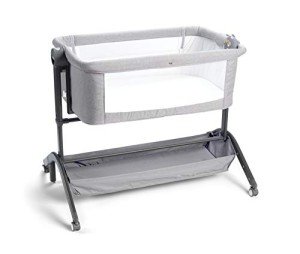 Bedside cribs can be utilized by mothers recovering from a C section. They can also be used while laying down. They can assist your baby learn to sleep in their crib by themselves and help them develop independence. The separation they create between your bed and theirs decreases the chance of being suffocated. There are many options available from budget-friendly models to expensive ones. Some cribs are smaller and can be folded to store away, whereas others come with a handy travel bag that allows you to take them to the beach on weekends. You must also think about how big your bedroom is and if the crib will fit. remember your baby may grow out of it earlier than you anticipate so don't make your choice too small. If you're looking for a crib simpler to assemble it's the Cozee XL is one of the quickest to build during MFM tests and features an attractive oak base. It also comes with an anti-reflux incline and opening side panel, as well as being easy to clean. It's suitable for most bedframes, but it may be difficult to fit if your divan is slightly different. If you're looking for a stylish, premium bedside crib that includes the mattress as well as a carry bag, this option from Chicco is worth a look. Its unique design has a perforated base that boosts airflow, and it has various height adjustments for your growing baby. It is also easy to clean and has a handy under-seat storage space for nappies and wipes.